Dune: Awakening Exchange & Landsraad Guide
Last updated on May 20, 2025 by MMOJUGG Team | Game: Dune Awakening Guide | Tags: Dune Awakening Exchange
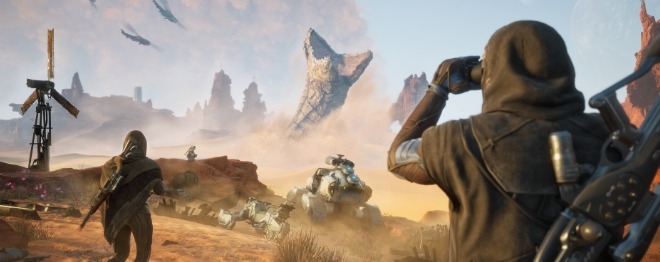
As Dune: Awakening approaches its June 10, 2025 release (head start June 5), the third livestream unveiled its Exchange and Landsraad systems, blending survival gameplay with MMO-style economy and politics. These features let you trade rare items and shape Arrakis's rules, whether you're a solo explorer or a guild strategist. Please bookmark our site and check out our store for more Dune guides, solari and spice.
This guide dives into the Exchange's trading mechanics, the Landsraad's political gameplay, and their rewards. Let's seize control of Arrakis.
The Exchange: A Dynamic Auction House
The Exchange is Dune: Awakening's auction house, accessible only in social hubs like Harko Village and Arrakeen. It fosters a player-driven economy worldwide (a collection of seiches, or servers), pushing beyond typical survival games. Here's how it works:
The purpose is to buy and sell items, blueprints, and data, connecting crafters, architects, and PvPers. It's located in social hubs to encourage player interaction and logistics.
Key Tradables:
Solido Replicators: Blueprints of base designs (e.g., forward operating bases or artistic builds like the beta's scorpion). Buyers preview and purchase designs, then craft the pieces themselves. Architects can earn a living selling creative or efficient bases.
Sync Charts: Maps from cartography surveys, detailing resources in Hagga Basin or the Deep Desert's 81 weekly resetting zones. Scouts sell charts to guilds or players, building reputations as reliable cartographers.
Unique Schematics: Rare, limited-run blueprints found in the Deep Desert. Sell the schematic or craft and sell the item (e.g., weapons, armor, tools). Explorers choose between crafting exclusivity or trading raw schematics.
Economy Dynamics: Enables diverse playstyles—architects, scouts, crafters, and PvPers contribute unique goods. PvE players access Deep Desert items via the Exchange, bridging playstyles.
Logistics: Visiting social hubs to trade or pay base taxes adds immersion, though forgetting taxes (as seen in beta) risks base decay.
How to Trade with Players
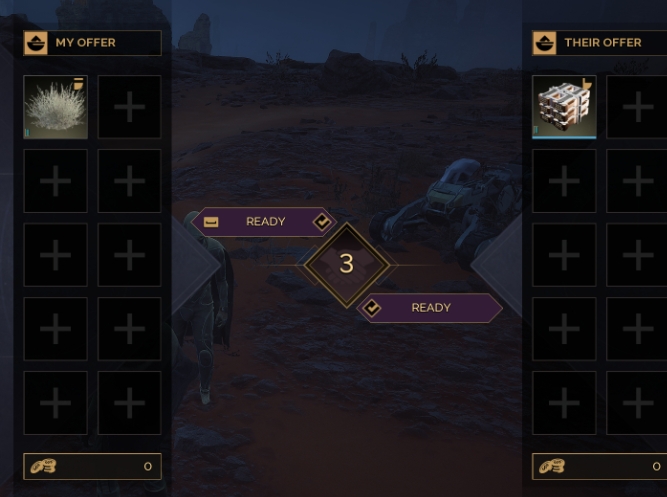
Direct player trading offers a hands-on alternative to the Exchange, ideal for quick swaps or guild coordination. Here's how it works:
The trading interface with another player shows a player's inventory on the left side.
Initiating a Trade: Hold the interact key (default: F) while looking at another player to open the radial wheel. Select the trade option (two arrows) to launch the trading interface.
Trading Interface: Your inventory appears on the left, allowing you to offer any item, from basic materials to high-end resources unavailable to the other player. Both players propose items, review the trade, and must accept for it to finalize, ensuring no one is cheated.
Beta Challenges: Trading was buggy in beta, with trades often failing despite mutual agreement. If this happens, retry the trade. Future patches may address persistent issues.
Alternative Method: Drop items on the ground for others to pick up. This is faster but riskier, as anyone can grab dropped items, making it easy to "steal" or back out of deals. Trade with trusted players or guildmates when using this method.
Tips: Use direct trading for quick guild resource swaps or informal deals. For high-value items, stick to the Exchange or ensure mutual trust to avoid scams.
The Landsraad: Political Power and World-Changing Decrees
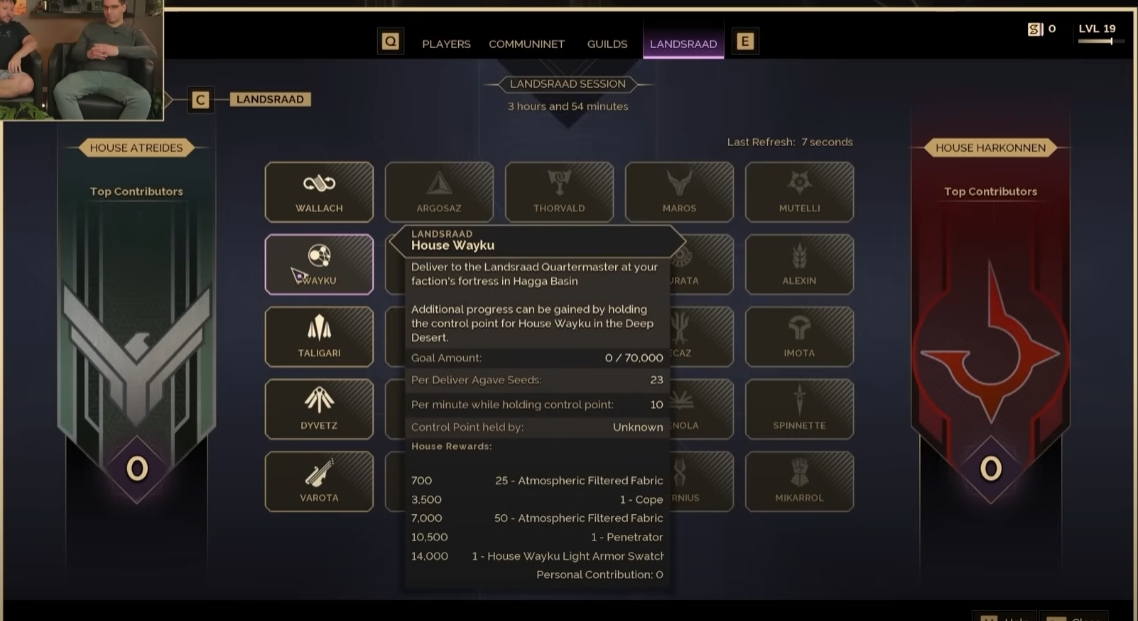
The Landsraad, inspired by Dune's high council, is an endgame system where guilds aligned with Atreides or Harkonnen compete to influence Arrakis's rules. It's a weekly cycle impacting an entire world, blending PvE and PvP activities. Here's the breakdown:
Mechanics
Eligibility: Players must align with a faction (Atreides or Harkonnen) and join a guild pledged to the same faction.
Weekly Cycle:
Task Revelation: Find representatives of 25 major houses across Arrakis to reveal their weekly tasks. Convince them via chores, bribes, or leveraging character background (e.g., caste or origin). Tasks auto-reveal over time, but early discovery gives more completion time.
Tasks:
Crafting: Harvest resources or craft items (stillsuits, rapiers, sandbikes, ornithopters) for delivery.
Exploration: Locate crash shipwrecks or buried treasures.
PvP: Control Deep Desert points for territorial dominance.
Landsraad Board: A 5x5 grid tracks task completion. Each square represents a house's task, filled in faction colors (Atreides or Harkonnen) as completed.
Winning Conditions:
Sisle Raad: Complete a row of five tasks (horizontal, vertical, or diagonal) for an early victory, named after a Dune voting bloc.
Most Tasks: If no Sisle Raad, the faction with the most tasks completed by week's end wins.
Tactics: Block opponents by completing tasks in their potential Sisle Raad rows, requiring strategic guild coordination. Collaborate with allied guilds to counter enemy strategies (e.g., blocking PvP-focused decrees).
Rewards
Decrees: The winning faction's guild leaders vote on one of three decrees, using voting power based on member contributions. Decrees alter world rules for a week, e.g.:
Access to vendors with powerful weapons, armor, tools, vehicles, or unique schematics.
Reduced crafting costs for the faction.
Full-loot PvP in the Deep Desert, favoring hardcore PvPers.
Personal Rewards: All contributors earn rewards per house task, regardless of victory:
Solari (currency), endgame components, unique schematics, or house-specific swatches (e.g., armor colors).
Low contribution thresholds ensure accessibility.
Guild Prestige: Top five contributing guilds per faction are displayed, fueling intra-faction competition. High contributors gain more voting power, influencing decree selection.
Lore and Impact
Lore Context: The Landsraad, a political tripod with the Emperor and Spacing Guild, influences Imperium policies. In-game, it drives the Atreides-Harkonnen war, with decrees shaping Arrakis's gameplay.
World Impact: Decrees affect all seiches in a world, making guild actions globally significant. PvE guilds can block PvP decrees, balancing playstyles.
Evolution: At launch, the Landsraad will be robust but will expand with new tasks and decrees as the game grows, ensuring long-term depth.
FAQs About Dune: Awakening Exchange and Landsraad
1. How do I access the Exchange?
Visit social hubs (Harko Village, Arrakeen) to buy/sell items like Solido Replicators, Sync Charts, or schematics. The site is worldwide and connects all seizures.
2. What can I trade on the Exchange?
Base blueprints (Solido Replicators), Sync Charts (resource maps), unique schematics, or crafted items from schematics.
3. How do I participate in the Landsraad?
Align with Atreides or Harkonnen, join a guild pledged to the same faction, and complete weekly tasks (crafting, exploration, PvP) to earn votes.
4. What are Landsraad decrees?
Winning guilds vote on decrees (e.g., unique vendors, reduced crafting costs, full-loot PvP) that alter world rules for a week.
5. Can I earn Landsraad rewards without winning?
Yes, personal rewards (Solari, schematics, swatches) are earned per task contributed, and accessibility thresholds are low.
Thanks for Reading
Dune: Awakening's Exchange and Landsraad systems empower you to trade rare designs, scout valuable resources, and shape Arrakis's politics. From selling Sync Charts to voting on game-changing decrees, your actions ripple across worlds. Stay tuned to MMOJUGG for more guides and beta updates. See you in the Deep Desert! 👉 [Explore our Dune: Awakening Ultimate Guides Hub Now]
Table of Content
 Buy Dune Awakening Solari
 Buy Dune Awakening Items
 Dune Awakening Boosting